

By Prof. Dima Jamali
I have been asked, more than once this past year, whether we should even be here.
Not in the philosophical sense. In the very practical one. Whether holding classes, running programs, asking students to submit assignments and sit for exams and prioritizing their futures — whether any of that is appropriate when the world outside is as loud and as frightening as it has been.
I understand the question. I have contemplated it myself. And I have come to believe, with more conviction each time I encounter one of our students, that the answer is not just yes — it is a resounding yes and especially now. More urgently now than ever.
They Kept Going
Before I say anything about higher education policy, or institutional responsibility, or the global frameworks we use to evaluate universities in conflict — I want to say something about the students.
Because they are the argument. Every one of them.
“During this period of war, I have been doing my best to balance both my online work and classes while adapting to the ongoing uncertainty. This experience has strengthened my resilience and my ability to remain committed to my responsibilities despite external challenges.”
— Joulan Abdelkhalek, ITM student
Joulan is describing something that no resilience framework fully captures: the daily, grinding, unglamorous work of continuing and persisting despite the war. Of opening a laptop when everything in you wants to close it. Of submitting an assignment when the news is unbearable. Of choosing, to stay present in your education when the world is demanding your attention elsewhere.
“Living through the war has taught me how fragile life can be, but also how strong people are when they have no choice but to endure. I've learned to find comfort in small moments — family, laughter, and hope — despite everything around me.”
— Ziad Al Halabi, ITM student
There is a kind of wisdom in those words that I do not think can be taught in a classroom. But I do think they can be honoured by one — by an institution that refuses to abandon its students when the pressure to do so is at its peak.
What War Does to Education — and What It Reveals
War does not simply pause education. It dismantles the conditions education depends on: safety, continuity, infrastructure, mental bandwidth, hope. It displaces students and faculty. It destroys libraries and laboratories. It compromises the quiet that thinking requires.
But it does something else — something less discussed. It reveals how resilient our educational systems were to begin with. The institutions that survive conflict are rarely the ones with the most resources. They are the ones with the clearest sense of why they exist.
“We cannot control the outcome of a war. But what we can control is our own environment — choosing to donate, choosing to volunteer, choosing to strengthen our relationships. Maybe you can't help 1.5 million people, but try helping one, even if that person is yourself.”
— Mohamad Bahij Jamil, ITM student
What Mohamad is describing — the discipline of focusing on what is within your reach — is not just a coping strategy. It is, I would argue, the foundational mindset of both education and leadership. You cannot build everything. But you can build something. And that something matters.
The University as an Institution of Last Resort
In stable societies, universities occupy a comfortable distance from the chaos of the world. They are places of formation, reflection, of long time horizons, of ideas that are allowed to grow.
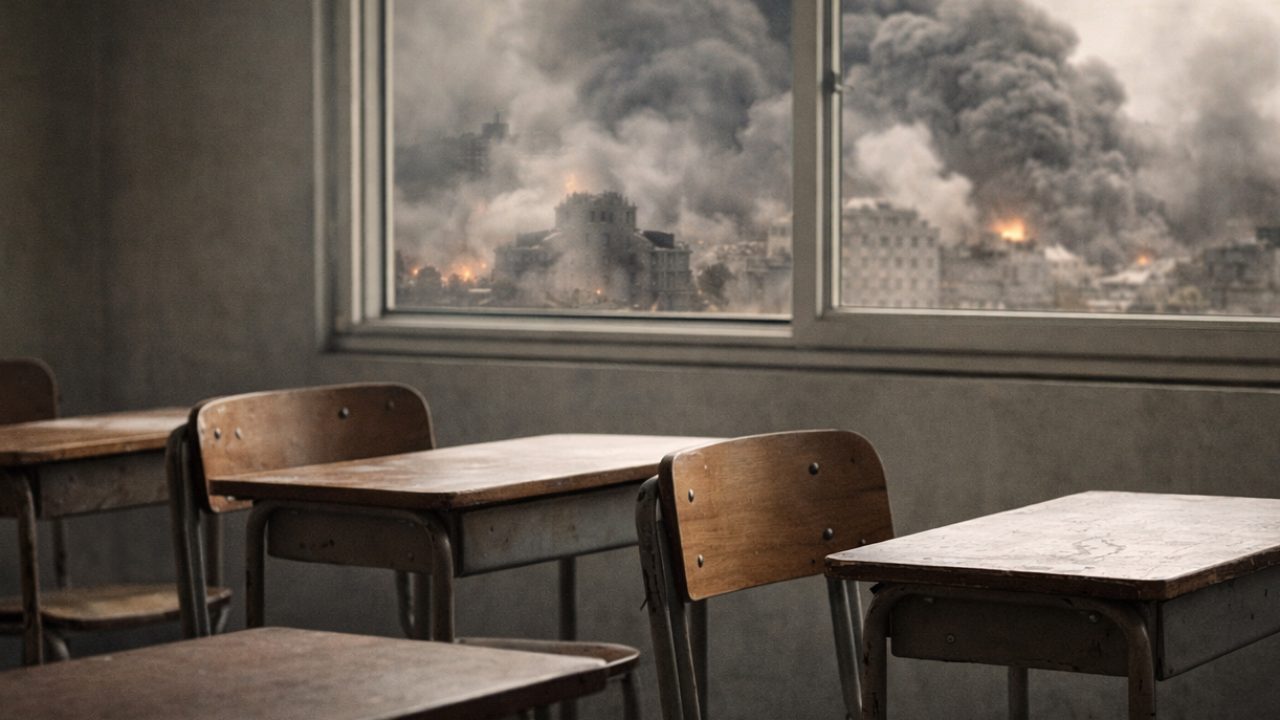
In fragile or conflict-affected societies, that distance collapses. The university becomes something different — closer to a lifeline than a library. It is often one of the few institutions still functioning, still gathering people, still insisting that the future exists and is worth preparing for.
This changes everything. It means institutional leadership can no longer be purely administrative — it must be pastoral, moral, and present. It means the curriculum cannot be designed only for the job market of five years from now; it must also meet students where they are right now. And it means that the act of keeping a university open — of refusing to cancel the semester, of insisting a student's education and graduation continue even as the world contracts — is itself a form of courage.
“Despite everything, we have come together to support our communities — collecting donations, distributing food to displaced families. These small acts remind us that even in crisis, compassion remains strong. We hold on to hope that through unity and perseverance, better days will come.”
— Mohamad Hazimeh, ITM student
When students show this kind of solidarity and compassion — when they extend themselves outward even while carrying their own weight — the university's obligation becomes even more pronounced. We must create conditions that accommodate these students and allow them to survive and to thrive. We must be worthy of them.
What Conflict Teaches Us About Learning
Two decades of research and lived experience in higher education across fragile contexts have taught me this: students who learn through adversity — who are asked to think critically not in the abstract, but under real pressure — develop a quality of judgment that is genuinely rare.
They learn to distinguish between what is urgent and what is important. They learn to function under cognitive load. They learn that leadership is not a title conferred in good times, but a choice made under difficult ones.
“I have learned the difference between being affected by a crisis and using it to justify stepping back from responsibility. Growth comes from choosing discipline and commitment despite circumstances.”
— Saad Al Ahmadieh, Finance student
Saad's distinction is sharp and important. There is a difference between acknowledging difficulty and being defined by it. The students who understand that difference — and act on it — are developing something that no stable, comfortable educational environment could have shaped.
These are not soft outcomes. In a world that prizes resilience, adaptability, and ethical clarity, these are among the most valuable things a university can produce. The question is whether we are designing for them — or simply hoping they emerge as a byproduct of circumstance.
What Higher Education Must Do Differently
For universities operating in or near conflict zones — and there are far more of them than comfortable global rankings would suggest — the challenge is not simply survival. It is adaptation without abdication. Three things matter above all:
PROTECT THE PSYCHOLOGICAL CONTRACT WITH STUDENTS
When the world outside is unpredictable, the university must become a space of reliable commitment. Not false reassurance — students see through that. Genuine, consistent presence. Show up. Keep the lights on. Answer the emails. The message that sends is more powerful than any curriculum.
REDESIGN LEARNING FOR DISRUPTED CONDITIONS
Hybrid and asynchronous models are not pandemic-era compromises. In conflict-affected regions, they are infrastructure. Universities that have not invested in flexible delivery are one escalation away from being unable to serve their students at all.
MAKE MEANING CENTRAL, NOT PERIPHERAL
In moments of acute crisis, students do not need more content. They need context. Professors who are willing to look beyond the syllabus and acknowledge what is happening. Who can connect what is being taught to the world around them. This is not activism. It is pedagogy.
A Conversation the Sector Is Not Having
The global higher education community — rankings bodies, accreditation agencies, international partnerships — largely operates as though conflict is an exceptional condition. A footnote. A force majeure clause.
It is not exceptional. For a significant portion of the world's students and institutions, instability is simply the baseline. And the frameworks we use to evaluate and fund higher education have not caught up with that reality.
What would it look like if they did? What if resilience — institutional, pedagogical, psychological — were a criterion for academic excellence, not merely a category for emergency relief? These are questions the sector needs to start asking seriously. Because the next crisis is not hypothetical. And the universities that will matter most in its aftermath are the ones that refuse to treat education as a fair-weather enterprise.
“When pushed to the brink, a lot of us come out of that fire reforged — stronger, more knowledgeable, more durable. I have faith that every bit of growth gained from these harrowing challenges will act as seeds of change, both within us as individuals and this country as a whole.”
— Anonymous student, Marketing
Seeds of change. Seeds of hope. That is what education plants, even in the hardest ground. Especially in the hardest ground.
The classroom is not separate from the world. It never was. Nor can the world be separated from what is happening in the classroom.
Prof. Dima Jamali is a scholar, educator, and Dean with over two decades of experience in higher education across fragile and emerging contexts. Her work focuses on sustainability, responsible leadership, and institutional resilience.