
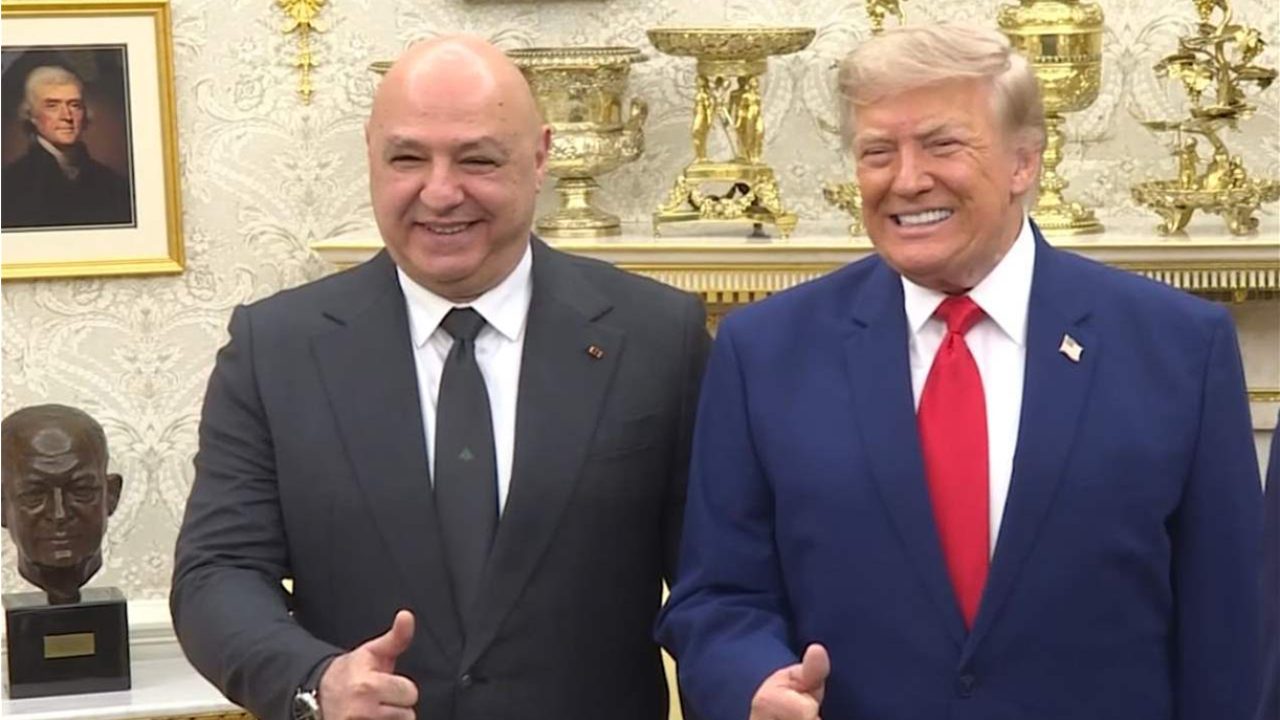

Some diplomatic visits belong to the realm of protocol. Others mark historic turning points.
President Joseph Aoun’s visit to Washington undoubtedly falls into the latter category. It goes far beyond the framework of bilateral relations between Beirut and Washington and forms part of a broader regional dynamic through which U.S. President Donald Trump seeks to reshape the Middle East according to a vision built on a simple yet ambitious principle: peace through stability, the sovereignty of states, and an end to protracted conflicts.
Since returning to the White House, Trump has pursued a distinct vision. Some may reduce that vision to the military operation targeting Iran’s nuclear facilities, but such an interpretation remains incomplete.
While the military operation represented a pivotal moment, it came only after decades of negotiations, mediation efforts, sanctions, and diplomatic initiatives led by successive Republican and Democratic administrations, all aimed at containing Iran’s nuclear program and avoiding a wider regional confrontation. According to this logic, force was used only after all other options had been exhausted.
This combination of firmness and the pursuit of a new regional balance now defines the contours of the American strategy.
Against this backdrop, many believe that Donald Trump is not seeking simply to win a war but rather to establish a lasting peace founded on strong states, respected borders, and institutions capable of exercising full sovereignty.
Should this vision succeed, talk of a Nobel Peace Prize for the American president may no longer seem as surprising as it does today. History has often honored leaders whose methods were controversial but whose results transformed entire regions.
Within this emerging regional order, every leader who chooses to embrace this dynamic becomes a partner in the making of peace.
It appears that President Joseph Aoun has now become one of those leaders.
From the very first moments of the visit, observers were struck by a noteworthy diplomatic gesture.
Rather than waiting for his Lebanese counterpart inside the White House, President Trump personally came outside to welcome him and accompanied him to the entrance of the Oval Office.
In American diplomatic practice, symbolic gestures often carry significance equal to that of words.
Throughout the meeting, Trump made a point of demonstrating considerable respect and appreciation for his Lebanese guest, in what appeared to be a political message directed both to the Lebanese people and to the broader region: Lebanon has once again become a priority in American attention.
This scene was not merely a matter of protocol; it reflected Washington’s desire to incorporate Lebanon into the region’s emerging strategic framework.
At this pivotal moment, President Joseph Aoun rose to the occasion. Despite the immense pressure that was clearly visible, he remained composed throughout the meeting and presented positions that were precise, clear, and free of ambiguity.
Since his election, the President has adopted a patient approach, seeking to open channels of dialogue with Hezbollah in an effort to fully integrate it into the institutions of the Lebanese state, based on the conviction that lasting solutions can only be achieved through comprehensive national consensus.
This approach drew significant domestic criticism, with many arguing that the process was moving too slowly. Nevertheless, the President insisted on giving dialogue every opportunity before moving to a new phase.
That extended hand, however, did not produce the desired results.
Washington’s visit now appears to open a new chapter—not one based on confrontation, but on a state that gradually assumes full responsibility for its sovereign duties.
No discussion of this new phase would be complete without recognizing the central role played by the Lebanese Armed Forces.
For months, the army has become the backbone of national stability.
Its Commander, General Rodolphe Haykal, has demonstrated on a daily basis a strategic understanding of Lebanon’s security challenges through an approach that combines discipline, professionalism, and the ability to anticipate risks, preserving the unity of the military institution while adapting to the country's evolving realities.
At this decisive stage, the army is no longer merely the guarantor of security; it has become one of the principal pillars upon which Lebanese state sovereignty may ultimately be rebuilt.
Equally significant in this equation is Speaker of Parliament Nabih Berri.
By virtue of his position and influence within Lebanon’s Shiite community, he remains one of the country's indispensable balancing figures.
At a time when every word, every position, and every decision carries direct consequences for Lebanon’s future, his role remains essential in accompanying any political transition while preserving national cohesion.
Yet beyond the official statements, perhaps the most significant outcome of the visit was the political message delivered by President Joseph Aoun.
It was a message of peace.
A peace that does not signify weakness or surrender, but rather the restoration of state authority, the strengthening of national institutions, and the rejection of Lebanon remaining an arena for settling regional conflicts.
This vision aligns closely with the approach Washington is seeking to establish across the Middle East—one that replaces the rule of militias with the authority of states, perpetual confrontation with dialogue, and chaos with sovereignty.
For that reason, this visit extends far beyond a bilateral meeting between two presidents.
It may well represent one of the first milestones in the peace process the United States seeks to consolidate throughout the region.
History alone will determine whether this course ultimately succeeds.
What is certain, however, is that some meetings alter the course of history.
And the Washington meeting may prove to be one of them.
If this momentum continues, Lebanon may finally reclaim its natural role as a land of dialogue, freedom, and coexistence.
And then, the Land of the Cedars may once again rise like the Phoenix—not through a miracle, but through the determination of leaders who chose peace over conflict, the state over division, and the future over the wounds of the past.